

Bee-Plane Medical Module
Air Hospital Module
A detachable airborne medical unit designed for rapid deployment, emergency response and modular healthcare operations.
Medical Configuration
Designed for airborne healthcare missions
20
Passenger seats
8+3
Patient beds
2
Surgical units
4
Crew rest beds
The Vision
Revolutionizing aerial medical services
The BeePlane Hospital Basket is a modular airborne medical unit developed within the Bee-Plane detachable-fuselage concept.
It brings advanced healthcare capability into an aircraft architecture designed for flexibility, rapid deployment and multi-mission operations.
This module can support disaster relief, humanitarian crises, military operations and strategic patient transport.
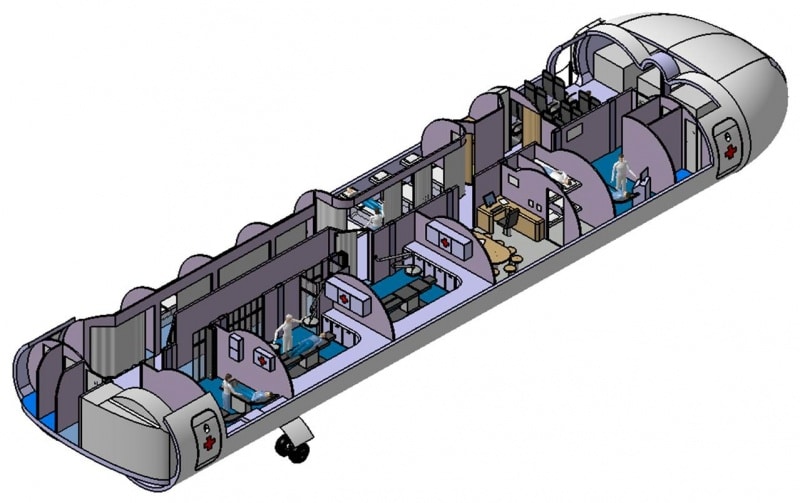
Modular Deployment
A detachable hospital ready for crisis zones
The Hospital Basket was initially explored during the early TRL1 phase and has since evolved within the TRL3 framework.
The current concept is aligned with the updated bi-open rotor Bee-Plane platform, structural integration constraints and operational deployment requirements.
Once detached from the Bee, the medical Basket can also operate as a ground-based facility, reducing setup time in emergency environments.
Core medical layout
- Two surgical units in the rear section
- General medicine and consultation area at the front
- Crew rest area in the central zone
- Single-bed and multi-bed patient rooms
- Ground-operable medical module after detachment
Design Features
Adaptable by mission, not locked into one layout
The Hospital Basket is not designed as a fixed airborne hospital. It is conceived as an adaptable medical environment that can evolve depending on the mission.
Flexible interior
Surgical areas, intensive care beds, triage spaces, consultation rooms and patient transport layouts can be reorganized according to operational priorities.
Independent upgrades
Medical systems can be upgraded, replaced or serviced independently from the flying platform, improving long-term maintainability.
Rapid mission switch
Switching from passenger or cargo configuration to a medical facility requires a module exchange, not a structural aircraft redesign.
Hospital Layout
Medical care organized inside a detachable fuselage
The concept includes two surgical units in the rear section, regular medicine and consultation areas at the front, and crew rest spaces in the middle.
Project Specifications
Aircraft capabilities and medical allocation
Capacity
20 passenger seats, 8+3 patient beds, 2 surgical units, radiology suite and 4 crew beds.
Medical spaces
Consultation, radiology, preparation rooms, storage areas, sanitary facilities and patient care zones.
Supply chain
Just-in-time replenishment, quality control and logistics integration with ground-based facilities.
Compliance
Medical aircraft certification, digital traceability and synchronized quality audit systems.
Space Allocation
A functional airborne care environment
The Hospital Basket is organized to support both emergency procedures and stabilized patient care during transport.
- Front storage area for essential medical equipment
- Consultation and radiology suite
- Crew rest area with dedicated beds
- Two surgical units for emergency procedures
- Rear preparation and consultation room
- Sanitary facilities and additional rear storage
Advantages
Why a detachable hospital fuselage matters
Rapid deployment
Medical services can be deployed quickly to disaster-stricken or remote areas where time is critical.
Resource optimization
Medical supplies and equipment can be pre-stocked in dedicated modules before the aircraft arrives.
Scalable response
The modular nature of the Basket allows different configurations depending on patient volume and medical urgency.
Challenges
Key points to validate before deployment
The concept offers transformative potential, but several technical, regulatory and operational challenges must be addressed.
These include detachable fuselage engineering, aviation and healthcare certification, specialized supply chains and initial development investment.
Validation priorities
- Structural integration of the detachable fuselage
- Medical and aviation regulatory compliance
- Supply-chain readiness for emergency missions
- Ground handling and module exchange protocols
- Cost and certification pathway assessment
Medical Mobility
A rapidly deployable medical infrastructure for the future of aviation.
The Bee-Plane Hospital Basket transforms the detachable fuselage concept into a powerful healthcare platform for emergency response, humanitarian operations and strategic medical mobility.