
Bee-Plane Passenger Module
Passenger Floor Plan
A modular cabin layout designed to improve passenger flow, comfort, structural integration and operational efficiency.
Passenger Configuration
A cabin designed around capacity, circulation and modularity
Passenger capacity
Main aisles
Seating layout
2014 cabin study
Cabin Concept
Passenger experience integrated into the Basket
The Bee-Plane passenger floor plan represents the cabin layout inside the detachable fuselage, including seats, aisles, toilets, galleys, luggage areas and structural reinforcement zones.
The passenger Basket is designed to combine comfort, safety and efficient boarding while remaining compatible with the detachable-fuselage architecture.
The layout studies evolved from early TRL1 configurations toward more advanced TRL2 concepts focused on capacity, structural integration and passenger flow.
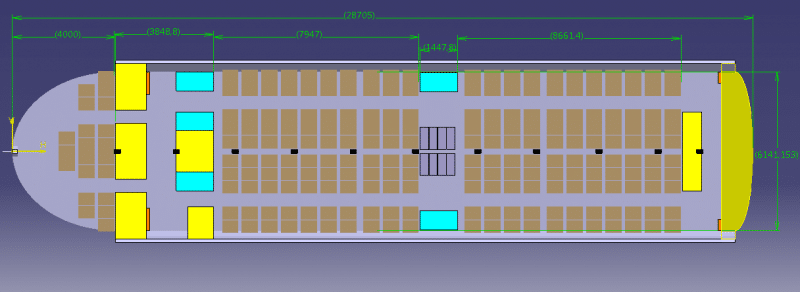
Cabin Layout Views
Floor plans and passenger arrangement studies
The following layouts illustrate seating organization, circulation areas, exits and the internal structure of the passenger Basket.
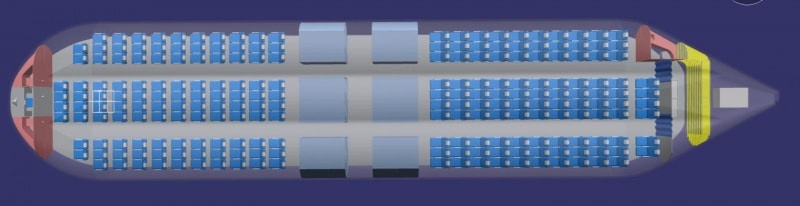

TRL2 Configuration
2014 design: higher capacity and reinforced structure
The TRL2 passenger configuration introduced a more advanced cabin architecture with a triple pressure bubble, two aisles and integrated reinforcement structures.
Triple pressure bubble
A cabin structure studied to improve pressure management and support a wider passenger module.
Two aisles
Two passenger aisles improve circulation, boarding flow and access to central exit doors.
220 passengers
The TRL2 study targeted a high-capacity passenger module with a full-economy layout.
TRL2 Features
A cabin organized for flow and structural efficiency
The TRL2 floor plan places the exit doors near the middle of the Basket, below the wings, to support efficient passenger movement.
The luggage area walls also serve as reinforcement structures, creating a dual-purpose interior architecture that supports both cabin function and structural needs.
- Triple pressure bubble structure
- Two aisles of reinforcement structures
- Central exit doors below the wings
- Galley areas in the middle and rear
- Single main passenger door on each side
- Luggage walls used as structural reinforcement
TRL1 Configuration
2013 Estaca 5A early passenger layout
The TRL1 configuration was an earlier and more conventional cabin study. It introduced the double pressure bubble concept and explored a simpler internal reinforcement architecture.
This early configuration used front and rear exit doors, two aisles and a central galley to support passenger service and circulation.
- Double pressure bubble configuration
- Single reinforcement structure
- Two passenger aisles
- Front and rear exit doors
- Central galley for balanced service
Comparative Analysis
From TRL1 simplicity to TRL2 capacity and integration
Efficiency
TRL2 improves space utilization with a wider structure, better aisle organization and more integrated reinforcement areas.
Capacity
The TRL2 concept supports higher passenger capacity, improving the economics of each flight.
Flexibility
The more advanced TRL2 architecture provides better potential for future cabin modifications and upgrades.
Operations
TRL1 remains simpler from an operational and maintenance perspective, but offers less integrated cabin performance.
Passenger Experience
Comfort remains central to the Bee-Plane vision
As the Bee-Plane design evolves, the passenger experience remains a central development objective.
The transition from TRL1 to TRL2 introduced significant improvements in cabin layout, structural design and passenger movement.
Future development phases may integrate advanced climate control, modern cabin services, increased personal space and smarter material choices to improve comfort and sustainability.
Future cabin priorities
- Improved passenger comfort
- Advanced climate control systems
- Modern entertainment and service options
- Optimized personal space
- Lightweight and durable materials
- Lower environmental impact
Development Outlook
Preparing the next generation of cabin design
The passenger Basket is not only a cabin. It is part of a wider modular aircraft system designed to improve operational efficiency, flexibility and passenger experience.
By integrating feedback from collaborative engineering partners and monitoring new technologies, each Bee-Plane iteration can improve cabin performance and operational value.
Design direction
- Passenger-first cabin development
- Modular interior logic
- Improved boarding and deboarding flows
- Structural integration inside the Basket
- Compatibility with future Bee-Plane configurations
Looking Ahead
Passenger comfort, modularity and efficiency in one cabin architecture.
The Bee-Plane passenger Basket demonstrates how detachable fuselage technology can reshape cabin design, aircraft operations and the passenger experience.