
Airbus A321 Analysis
The Airbus A321: A Deep Dive from Cutting-Edge Design to Global Supply Chain
The Airbus A321 stands out as one of the most advanced and adaptable narrow-body aircraft in the skies today. As the largest member of the A320 family, it combines aerodynamic refinement, innovative materials, and engineering excellence to deliver top-tier performance and cost-efficiency. Here’s a comprehensive breakdown of its specifications, design innovations, and its evolving role in aviation logistics.
Technical Specifications
Weight Profile
- Maximum Ground Weight: 78,400–89,400 kg
- Maximum Landing Weight: 73,500–75,500 kg
- Maximum Takeoff Weight (MTOW): 78,000–89,000 kg
- Operational Weight Without Fuel: 69,500–71,500 kg
These weight parameters are crucial for determining flight range and payload efficiency, especially on long-haul missions where MTOW heavily influences fuel performance.
Volume Capacities
- Usable Fuel Capacity: 23,700–29,700 liters (≈18,600–23,300 kg)
- Pressurized Cabin Volume: 418 m³
With expanded fuel storage, especially in the A321XLR variant, the aircraft can reach over 4,700 nautical miles—nearing wide-body capability while maintaining single-aisle economy.
Dimensions
- Fuselage Height: 4.14 m
- Tail Height: 5.87 m
- Wingspan: 34.1 m
- Tailplane Span: 12.45 m
- Total Length: 44.5 m
- Engine Placement: 5.75 m from the centerline
- Fuselage Width: 3.95 m
- Wing Attachment: ~17 m from the nose; ~6 m base width
These dimensions help optimize aerodynamic balance and fuel economy across flight regimes.
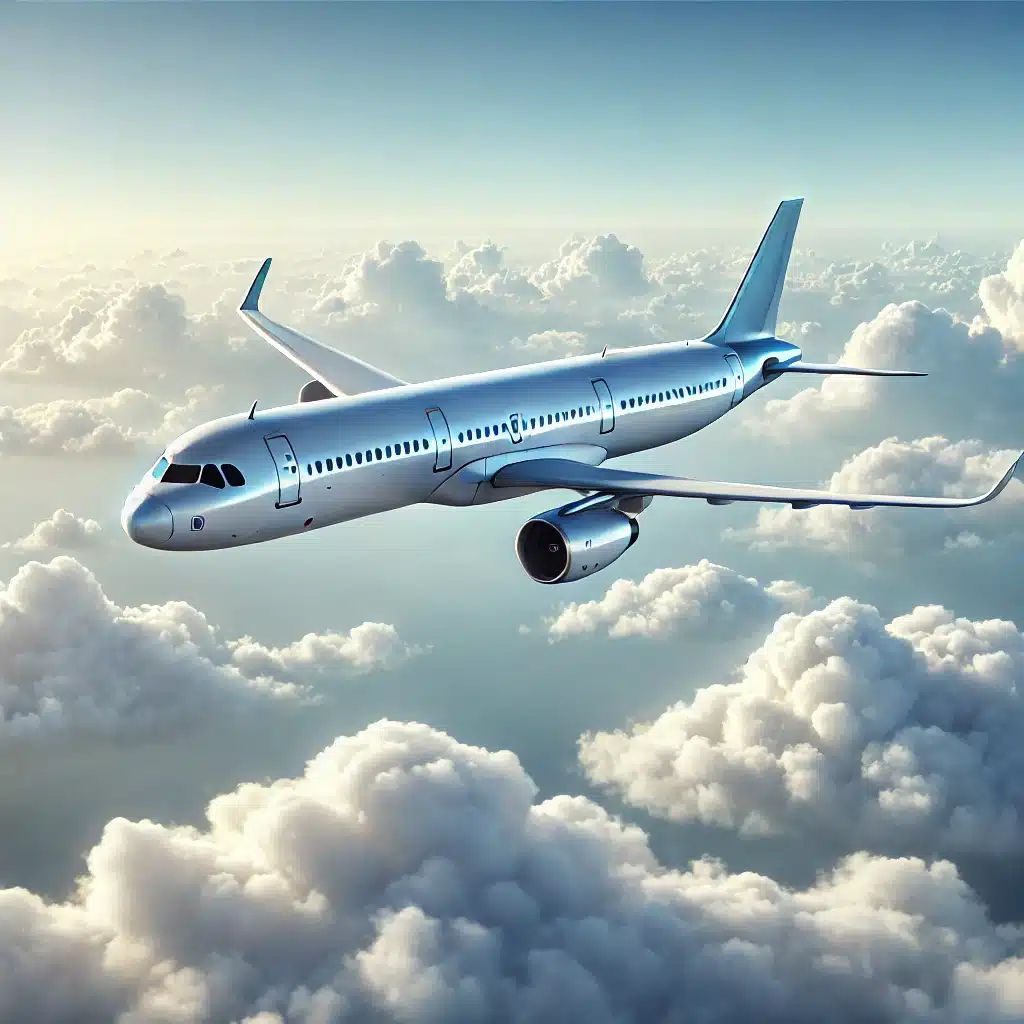
Design & Innovation
Aerodynamic Advancements
The A321’s Sharklets—2.4-meter wingtip extensions—cut drag and boost fuel efficiency by up to 4% on long routes. Combined with high-lift wing elements, the aircraft achieves excellent aerodynamic performance.
Materials & Structure
- Aluminum-Lithium Alloys: Deliver higher strength-to-weight ratios.
- Carbon Fiber Reinforced Polymers (CFRP): Used in critical areas like wing structures, cutting weight by up to 20%.
These materials reduce overall mass, improve durability, and extend aircraft life while minimizing fuel costs.
Cabin Configuration
The Airbus Cabin Flex (ACF) layout supports 185 to 240 passengers. With customizable galleys and lavatories, airlines can tailor cabin space for optimal comfort or maximum seating.
Engine Options
- CFM International LEAP-1A: High bypass ratio, composite fan blades, +15% fuel savings
- Pratt & Whitney PW1100G-JM: Geared turbofan tech reduces fuel burn, emissions, and noise
Both engines support lower carbon footprints while enhancing overall performance.
Operational Efficiency
Fuel Economy
- 15–20% lower fuel burn than earlier models
- Reduced emissions per seat, helping carriers meet sustainability goals
Fleet Commonality
With ~95% component and system commonality across the A320 family, the A321 ensures:
- Lower training costs
- Streamlined maintenance operations
- Flexible fleet deployment
Fast Turnaround Time
Efficient boarding, loading, and refueling allow for shorter Turnaround Time (TAT), translating into faster flight cycles and increased revenue potential.

Supply Chain & Production Strategy
Modular Manufacturing
Airbus uses a global modular build process—wings, fuselages, and tail units are manufactured worldwide, then assembled in Hamburg, Toulouse, or Mobile. This scalable approach enhances productivity and responsiveness to market demands.
Smart Vendor & Inventory Practices
Airbus applies strict supplier evaluations, real-time inventory tracking, and predictive analytics to:
- Maintain high part availability
- Lower holding costs
- Minimize Aircraft on Ground (AOG) incidents
Looking Ahead: The Future of the A321
As aviation pushes toward greener skies, the A321 is future-ready with upgrades for biofuel use, hybrid-electric propulsion, and next-gen materials. The A321XLR, for instance, brings intercontinental range to narrow-body jets—blurring the line between regional and long-haul service.